

PM Free Laptop Scheme 2026 Phase 4
PM Free Laptop Scheme 2026 Phase 4 Apply Now has once again become a major opportunity for students across Pakistan who want to move forward in education with the help of modern technology. In today’s time, a laptop is not just a luxury item but a basic need for students, especially those studying in universities and colleges. From attending online classes to preparing assignments and conducting research, everything now depends on digital access.
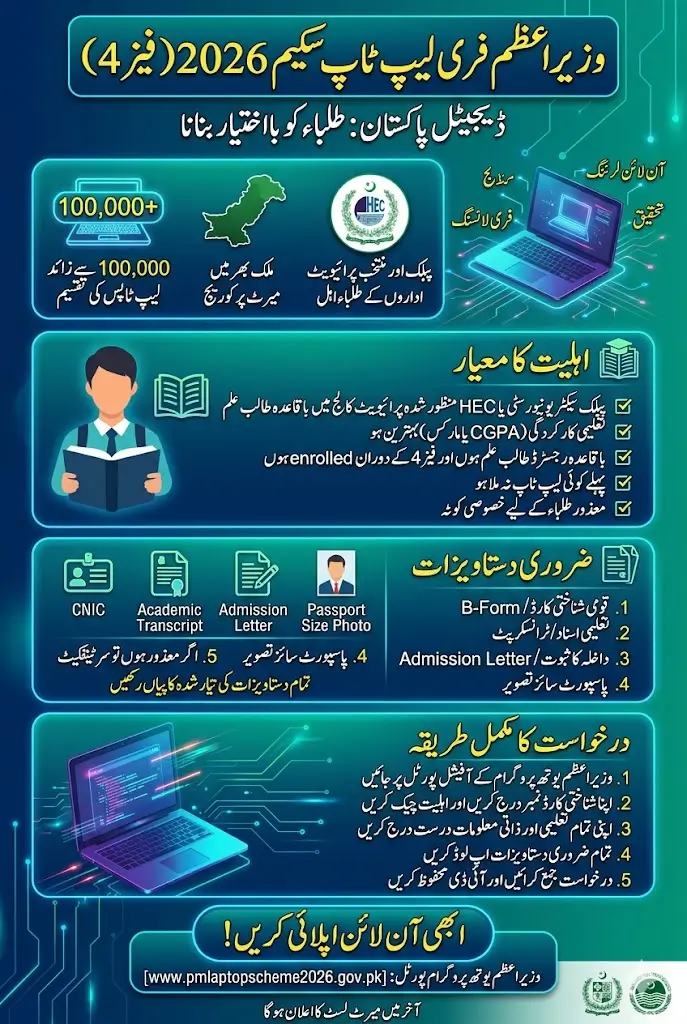
From a ground-level perspective, it is clear that many talented students in Pakistan still lack access to proper devices. This scheme directly targets that gap by providing free laptops on a merit basis. The government’s focus is not only on distributing devices but also on empowering students to become part of the digital economy, which is growing rapidly in Pakistan.
Overview of Phase 4 Distribution Plan
Under Phase 4 of the Prime Minister Laptop Scheme 2026, more than 100,000 laptops are expected to be distributed among deserving students. This large-scale distribution shows the government’s commitment to promoting education and digital access nationwide. Students from public universities and colleges are the main beneficiaries, while selected private institutions approved by HEC are also included.
This phase is more structured compared to earlier ones, with improved verification systems and better coordination between universities and authorities. Merit-based selection ensures that only hardworking and deserving students receive laptops, which builds trust in the system and encourages academic excellence among students.
- More than 100,000 laptops allocated
- Coverage across all provinces of Pakistan
- Focus on public sector institutions
- Inclusion of HEC-approved private universities
- Transparent and merit-based selection process
Main Objectives Behind the Scheme
The core aim of the PM Laptop Scheme 2026 is to strengthen the education system by integrating technology into students’ daily learning process. This initiative supports the vision of Digital Pakistan, where students are equipped with modern tools to compete globally.
By providing laptops, the government is encouraging students to explore online learning platforms, improve their research capabilities, and develop digital skills that are highly demanded in today’s job market. It also creates opportunities for freelancing and remote work, which have become important income sources for many Pakistani youth.
- Promote digital learning and smart education
- Support academic research and innovation
- Encourage freelancing and IT-based careers
- Reduce the digital divide among students
- Strengthen Pakistan’s digital economy
Eligibility Requirements for Applicants
Understanding eligibility criteria is very important before applying. Many students miss this opportunity simply because they do not carefully read the requirements. The scheme is designed mainly for students who are currently enrolled in recognized institutions and have a strong academic record.
Students must be regular and active in their studies. Those who have already received laptops in previous phases are not eligible again, as the aim is to benefit new students. There is also a special quota for students with disabilities to ensure equal opportunities.
- Must be enrolled in a public sector university or college
- Private students eligible only if institution is HEC-approved
- Must have good academic performance (CGPA or marks)
- Must be a regular student
- Must not be a previous laptop recipient
- Valid CNIC or B-Form is required
List of Documents Needed for Application
Before starting the application process, students should prepare all required documents. In many cases, applications get delayed or rejected due to incomplete or incorrect documentation. Keeping everything ready saves time and avoids unnecessary problems during verification.
These documents are used to confirm identity, academic performance, and enrollment status. It is important that all documents are clear, updated, and accurate to ensure smooth processing.
- CNIC or B-Form for identity verification
- Academic transcripts to check performance
- Admission letter or proof of enrollment
- Passport-size photograph for identification
- Disability certificate for special quota
| Document Type | Why It Is Required |
|---|---|
| CNIC / B-Form | Identity confirmation |
| Transcripts | Academic merit evaluation |
| Admission Proof | Verification of student status |
| Photograph | Personal identification |
| Disability Certificate | Special quota eligibility |
Complete Online Application Method
The application process for the PM Laptop Scheme 2026 Phase 4 is fully online, which makes it accessible for students in every part of Pakistan. Even students living in remote areas can easily apply using a mobile phone or computer with internet access.
Students need to visit the official Prime Minister Youth Program portal and start by entering their CNIC. After checking eligibility, they must fill in personal and academic details carefully. Uploading documents correctly is very important because errors at this stage can lead to rejection.
- Visit official PM Youth Program portal
- Enter CNIC and check eligibility status
- Fill personal information correctly
- Add complete academic details
- Upload all required documents
- Review application before submission
- Submit form and save application ID
Verification and Approval Procedure
Once the application is submitted, the process moves to the verification stage. Universities are responsible for verifying student data, including academic records and enrollment status. This step ensures that only genuine and deserving students are selected.
If any discrepancy is found, the application may be rejected. Therefore, students must ensure that all information provided is accurate and matches official records. This verification system increases transparency and reduces chances of misuse.
Selection Criteria and Merit Preparation
The selection process is entirely merit-based, which means academic performance is the key factor. Students with higher marks or CGPA have better chances of being selected. Each university prepares its own merit list based on student data.
This system allows fair competition among students within the same institution. It also ensures that deserving candidates are selected without any bias. Students are advised to stay updated through their university announcements.
- Merit based on CGPA or percentage
- Separate merit lists for each university
- No political or external influence
- Transparent and fair selection process
Laptop Distribution Process Explained
After the merit lists are finalized, selected students are informed through official channels. Universities usually arrange formal distribution ceremonies where laptops are handed over to students.
At the time of distribution, students may be required to go through biometric verification to confirm their identity. It is important to carry original documents on that day to avoid any issues.
- Official notification to selected students
- Distribution ceremonies at universities
- Biometric verification for authenticity
- Requirement of original documents
Advantages for Selected Students
Receiving a free laptop can be life-changing for many students in Pakistan. It opens new doors for learning, earning, and personal growth. Students can attend online classes, access global resources, and improve their skills.
Many students are now earning through freelancing platforms, and having a laptop is the first step toward that journey. This scheme not only supports education but also contributes to financial independence.
- Access to online education and courses
- Better research and assignment preparation
- Opportunity to start freelancing
- Reduced financial burden on families
- Improved digital and technical skills
Latest Progress and Expected Timeline
Currently, the registration process for Phase 4 is active, and students from across the country are applying. Universities have started verifying applications, which indicates that the process is moving forward as planned.
The merit list is expected to be announced after the registration deadline, while laptop distribution is likely to take place later in 2026. Students should apply early to avoid last-minute issues.
Official Support and Complaint Channels
Students who face any issues during the application process can contact official support channels. It is always recommended to rely on authentic sources instead of unofficial information available online.
HEC provides helpline services, email support, and regional office assistance. In case of serious issues, students can also submit complaints through official government portals.
- HEC helpline for guidance
- Email support via official portal
- Regional offices for assistance
- Complaint submission through official system
Common Questions Answered
Many students have common concerns regarding the PM Laptop Scheme 2026 Phase 4. Based on experience, most questions are related to eligibility, selection, and application process.
- Who can apply? Students enrolled in eligible institutions
- Is the laptop free? Yes, completely free
- How are students selected? Through merit
- Can previous recipients apply? No
Final Thoughts and Application Advice
The Prime Minister Free Laptop Scheme 2026 Phase 4 is one of the most important opportunities for students in Pakistan today. It provides not just a device but a chance to improve education, develop skills, and build a better future.
Students should take this scheme seriously, apply on time, and ensure that all information provided is accurate. With the right approach, this opportunity can help students move ahead in both education and professional life.